










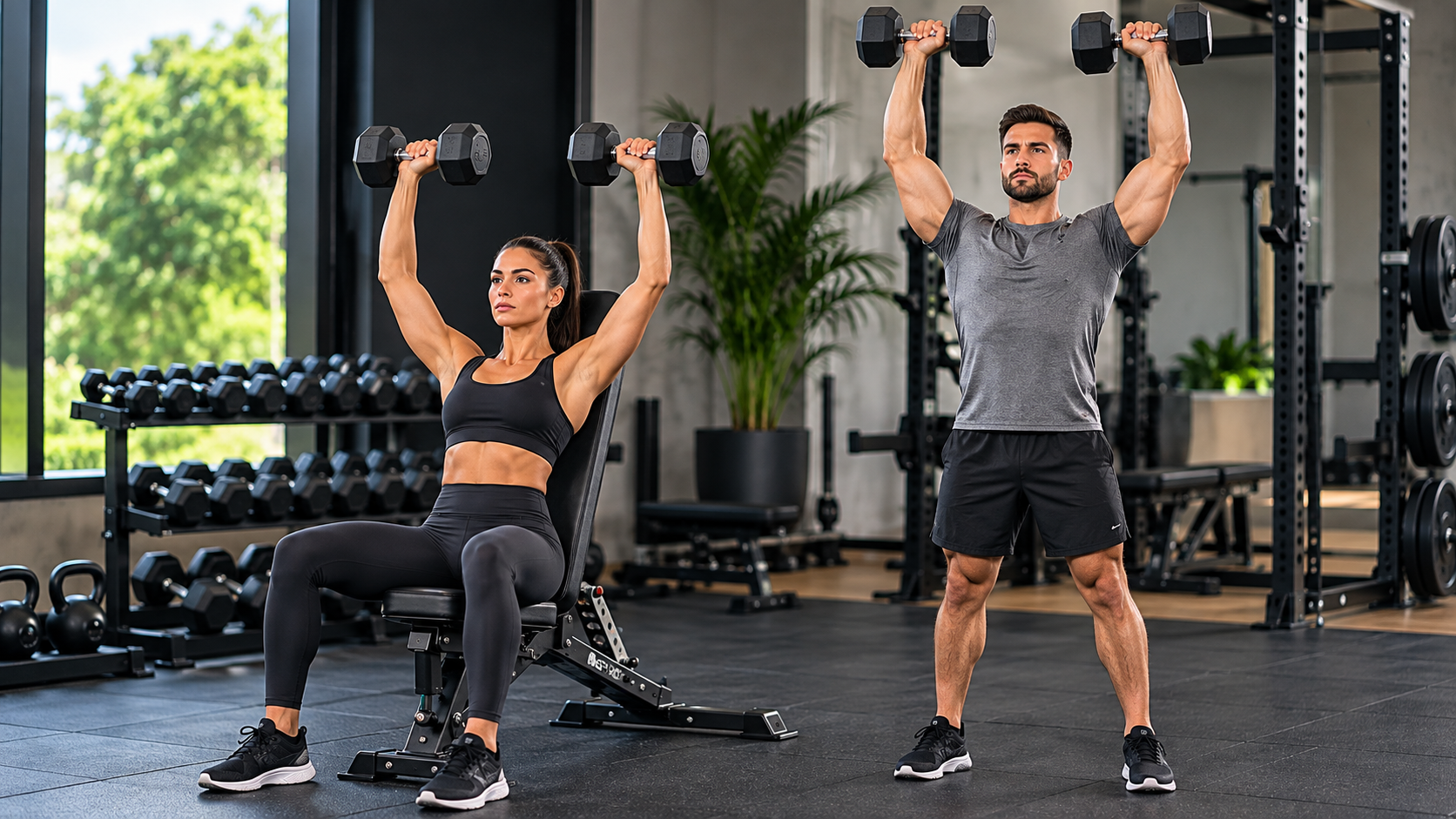
Seated vs Standing Dumbbell Shoulder Press
Both variations train the shoulders, but the setup and stability requirements are different.
Seated Dumbbell Shoulder Press
A seated press allows the bench to support your torso, making it easier to concentrate on controlling the dumbbells and maintaining a consistent pressing path.
Set the bench backrest upright or close to upright and sit with your back supported. Plant your feet firmly on the floor and keep your torso stable.
Bring the dumbbells to shoulder height using a controlled movement. If the weights are too heavy to position safely, reduce the load rather than struggling to get them into place.
Avoid deliberately creating a large lower-back arch simply to move heavier dumbbells.
A quality adjustable bench is useful here because the same bench can also support incline presses, flat presses, rows and numerous other dumbbell exercises.
Standing Dumbbell Shoulder Press
The standing version removes the support of the bench and requires greater whole-body stability.
Stand with your feet approximately hip- to shoulder-width apart and distribute your weight evenly.
Hold the dumbbells near shoulder height and brace your midsection before pressing.
Try to keep your ribs positioned over your pelvis rather than leaning backwards as the weights move overhead.
If you consistently need to lean back to complete repetitions, the dumbbells may be too heavy.
How to Perform a Dumbbell Shoulder Press
Start with the dumbbells around shoulder height.
Your palms can face forward or turn slightly inward if that position feels more comfortable.
Then:
- Plant your feet securely.
- Brace your torso.
- Position the dumbbells around shoulder height.
- Keep your wrists reasonably straight and aligned over your forearms.
- Press the dumbbells upward under control.
- Allow the weights to travel naturally rather than forcing them into a perfectly straight path.
- Extend your arms comfortably at the top without aggressively locking the elbows.
- Lower the dumbbells slowly towards shoulder height.
- Repeat while maintaining the same body position and controlled movement.
The dumbbells may move slightly towards one another as they travel overhead, but there is no need to bang them together at the top.
Your objective should be to control the resistance through the complete movement rather than simply moving the dumbbells from shoulder height to overhead.
What Muscles Does the Dumbbell Shoulder Press Work?
The dumbbell shoulder press primarily trains the deltoids of the shoulders, particularly the front and middle portions, while the triceps assist in extending the elbows during the press.
The upper back and surrounding shoulder musculature also contribute to stabilising the movement.
When performed standing, your trunk and lower body have a greater role in maintaining a stable position than during a supported seated press.
This makes both variations useful, but neither is automatically better.
The best choice depends on the type of training you are doing and which version allows you to perform controlled repetitions.
What Bench Angle Is Best for a Dumbbell Shoulder Press?
For a conventional seated dumbbell shoulder press, the bench should generally be upright or close to upright.
However, it doesn't have to be positioned at exactly 90 degrees.
A slightly reclined backrest can feel more comfortable for some lifters and still provide an effective shoulder press.
As the bench angle becomes progressively lower, the exercise begins moving away from a conventional shoulder press and towards an incline dumbbell press, increasing the contribution of the chest.
This is why questions such as “Should a shoulder press be performed at 60 degrees or 45 degrees?” need context.
At those lower angles, particularly around 45 degrees, you're increasingly performing an incline pressing movement rather than a traditional overhead shoulder press.
For more on that movement, read our guide:
Dumbbell Incline Press: Setup, Form, Bench Angle & Equipment
This replaces the SeoVision dashboard link in the original draft, which should definitely not appear on the published article.
Common Dumbbell Shoulder Press Mistakes
Excessive Back Arch
Some natural curvature through the lower back is normal.
The problem occurs when you significantly lean backwards or flare your ribs to turn the movement into an incline-style press.
Brace your torso and reduce the load if necessary.
Using Too Much Weight
If you have difficulty getting the dumbbells into position, cannot control the lowering phase or need momentum to complete each repetition, consider reducing the resistance.
Good repetitions with a manageable load are more useful than poorly controlled repetitions with heavier dumbbells.
Flaring the Elbows Excessively
You don't need to force your elbows directly out to your sides.
Allow them to sit in a comfortable position, often slightly forward of your torso, while keeping your hands and forearms aligned.
Bending the Wrists Back
Keep your wrists reasonably straight and the dumbbells supported over your forearms.
Allowing the wrists to collapse backwards can make heavier weights more difficult to control.
Bouncing at the Bottom
Reverse the movement smoothly rather than dropping rapidly into the bottom position and using momentum to begin the next repetition.
Rushing the Lowering Phase
The downward portion of the exercise is still part of the repetition.
Lower the dumbbells with control and aim to repeat a consistent movement from your first repetition to your last.
Dumbbell Shoulder Press Variations
You don't need to perform the shoulder press exactly the same way every time.
Neutral-Grip Dumbbell Shoulder Press
Turn your palms towards one another rather than directly forwards.
Some lifters find this position more comfortable for the shoulders.
Seated Dumbbell Shoulder Press
Use an adjustable bench for additional torso support and to make it easier to maintain a consistent body position.
Standing Dumbbell Shoulder Press
Perform the movement without back support, requiring more whole-body stability.
Single-Arm Dumbbell Shoulder Press
Press one dumbbell at a time.
The single-arm variation changes the stability demands and can also be useful when you have limited equipment.
Alternating Dumbbell Shoulder Press
Rather than pressing both weights simultaneously, alternate arms while keeping the opposite dumbbell controlled around shoulder level.
Whichever variation you choose, start with resistance that allows you to control the movement.
How Heavy Should You Go?
There is no universally “good” dumbbell shoulder press weight.
A 15kg dumbbell shoulder press, for example, may be relatively light for one experienced lifter and challenging for another.
The number on the dumbbell matters less than whether it is appropriate for your current strength and training goal.
A suitable working weight should allow you to perform your intended repetitions without:
- Excessive backward leaning
- Losing wrist position
- Using your legs to generate momentum
- Significantly shortening the movement
- Losing control during the lowering phase
Once you can complete your planned repetitions with consistent technique, consider increasing the resistance gradually.
Adjustable dumbbells are particularly useful for this because they provide multiple resistance settings without requiring numerous separate pairs.
Choosing Dumbbells for Shoulder Presses
Both fixed and adjustable dumbbells work well for shoulder pressing.
Fixed Dumbbells
Fixed dumbbells are simple and convenient. Pick up the required pair and begin training.
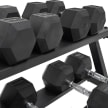
They're particularly suitable for larger home gyms and commercial facilities where there is room for a range of weights and a dumbbell rack.
Dumbbell Sets
A complete set provides multiple resistance options and makes gradual progression easier.
They're particularly useful where several people with different strength levels use the same equipment.
Adjustable Dumbbells
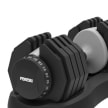
Adjustable dumbbells can be particularly useful in a home gym because a single pair can replace numerous fixed-weight dumbbells.
For shoulder training, this is useful because different exercises often require substantially different resistance.
You might use heavier weights for shoulder presses but considerably lighter settings for exercises such as lateral raises.
BowFlex 552i Adjustable Dumbbells
The BowFlex 552i SelectTech Adjustable Dumbbells are particularly well suited to general home strength training.
Each dumbbell adjusts from approximately 2.3kg to 23.8kg, providing 15 weight settings.
That broad range is useful for shoulder training because it can accommodate lighter isolation exercises as well as progressively heavier shoulder presses.
The compact design also makes the 552i attractive where floor and storage space are limited.
Best suited to: general home strength training, beginners through intermediate lifters and users wanting a broad selection of weights in a compact setup.
Link directly to the live Fitness Network BowFlex 552i product page here.
BowFlex 1090i Adjustable Dumbbell
For stronger users requiring greater resistance, the BowFlex 1090i SelectTech Adjustable Dumbbell extends the available range substantially.
Each dumbbell adjusts from approximately 4.5kg to 40.8kg across 17 weight settings.
The additional resistance makes the 1090i particularly suitable for experienced home lifters who also want to use the same adjustable dumbbells for heavier presses, rows, squats and other compound movements.
Best suited to: experienced home lifters and users wanting significantly greater long-term strength progression.
Choosing a Bench for Seated Shoulder Presses
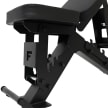
If you prefer seated shoulder presses, an adjustable weight bench gives you substantially more flexibility than a fixed bench.
Look for:
- A stable frame
- Multiple secure backrest positions
- Suitable load capacity
- Supportive back padding
- A stable base
- Enough adjustment for both upright and incline exercises
The advantage is that the same bench can be used for shoulder presses, incline dumbbell presses, flat dumbbell presses, rows and numerous other strength exercises.
The Vanguard Fitness Multi Adjustable Gym Weight Bench is one suitable option for a versatile home strength setup.
View Vanguard Fitness Multi Adjustable Gym Weight Bench
Dumbbell Shoulder Press FAQs
How do you correctly do a dumbbell shoulder press?
Hold the dumbbells around shoulder height with your torso stable and wrists aligned with your forearms. Press the weights overhead under control, extend your arms comfortably and then lower the dumbbells slowly towards shoulder level. Avoid excessive backward leaning or using momentum to complete the repetition.
Is a 15kg dumbbell shoulder press good?
There is no universal benchmark because appropriate resistance depends on your body size, experience, technique and training goals. Pressing 15kg dumbbells with controlled technique may be an excellent working weight for one person and inappropriate for another. Focus on progressive improvement rather than comparing the number with someone else's lift.
At what angle should I do a dumbbell shoulder press?
For a conventional seated shoulder press, use an upright or close-to-upright bench position. A slight recline may be more comfortable for some people. As the bench angle becomes lower, the movement increasingly becomes an incline press involving more of the chest.
Are shoulder dumbbell presses done at 60 degrees or 45 degrees?
A 45-degree bench position is generally much closer to an incline chest press than a conventional shoulder press. At approximately 60 degrees the shoulders become more involved, but for a traditional seated shoulder press the backrest is usually positioned more upright. Use the position that allows comfortable, controlled pressing.
Should I keep my elbows in or out during the overhead press?
Neither extreme is necessary. Your elbows can sit slightly forward of your torso rather than being pinned tightly against your body or flared directly out to the sides. Aim for a position where your wrists, forearms and elbows remain well aligned and the movement feels comfortable.
Are dumbbell shoulder presses good for building shoulder strength?
Yes. Dumbbell shoulder presses provide resistance to the shoulder muscles and triceps and can form part of a progressive upper-body strength programme. Increasing resistance gradually while maintaining consistent technique allows the exercise to continue challenging the muscles over time.
How should I position my wrists during a dumbbell shoulder press?
Keep your wrists reasonably straight and aligned over your forearms rather than allowing them to bend significantly backwards. This provides a more stable position for controlling the dumbbells.
What should I do if a shoulder press causes discomfort?
Stop or reduce the movement if it causes pain. Try a lighter load, a different grip, a supported seated position or a comfortable range of motion. Persistent or significant shoulder pain should be assessed by an appropriately qualified healthcare professional rather than repeatedly training through it.
Build Your Home Dumbbell Training Setup
A pair of suitable dumbbells and a quality adjustable bench can form the foundation of a highly versatile home strength setup.
The same equipment can be used for shoulder presses, incline presses, flat presses, rows, curls, triceps exercises, lunges, split squats and numerous other movements.
Start with equipment that suits your current strength and available space while giving you enough room to progress.