











1. What Is Treadmill Belt Size?
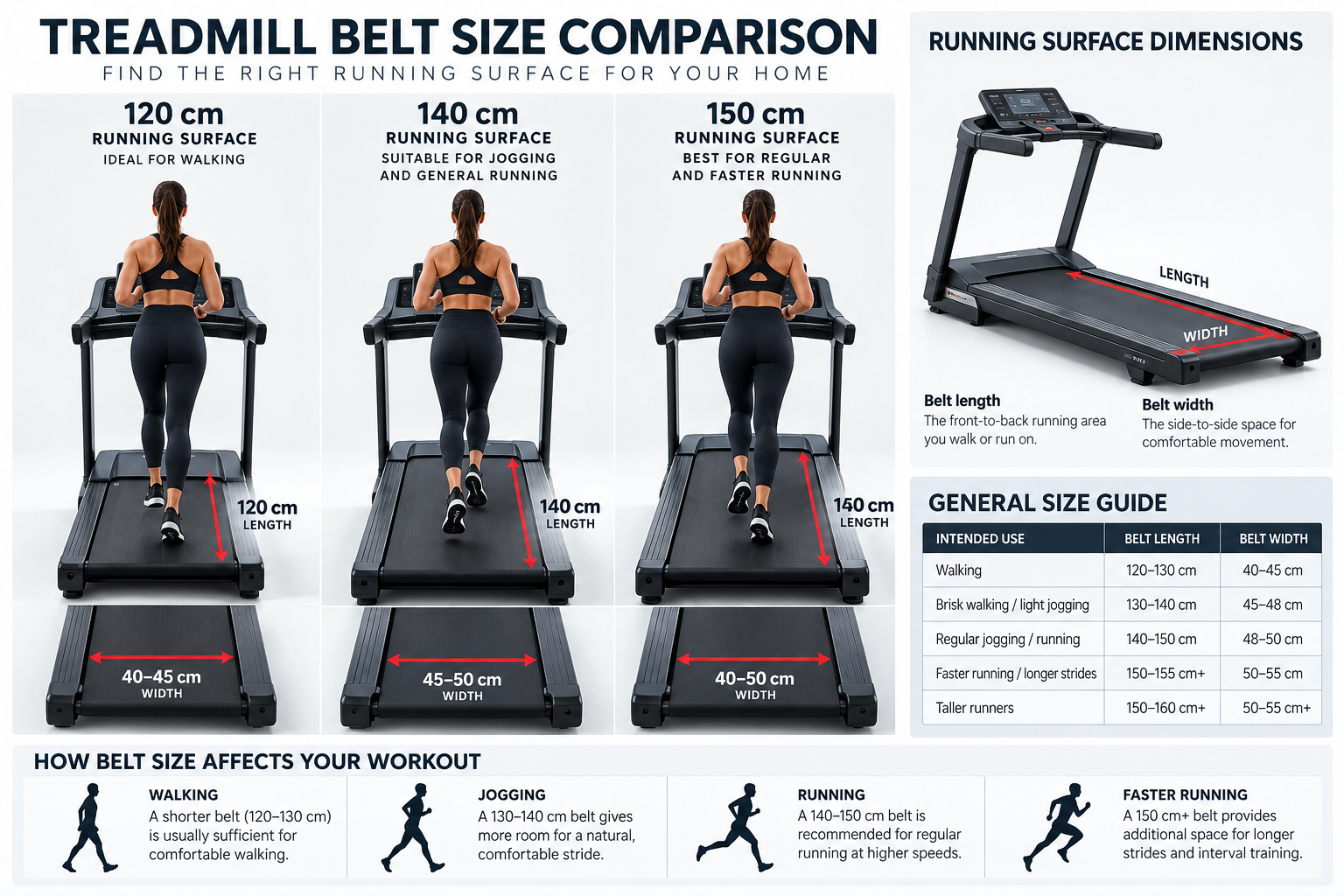
Treadmill belt size refers to the usable running surface of the treadmill.
It is normally expressed as two measurements:
- Belt length: The distance from the front to the rear of the usable running surface.
- Belt width: The side-to-side width available for walking or running.
For example, a treadmill advertised with a 140 × 50 cm running surface has a belt approximately 140 cm long and 50 cm wide.
These measurements are different from the treadmill's overall dimensions.
The machine's frame, side rails, motor housing and console all contribute to its total footprint.
When comparing treadmills, always check the specification labelled running area, running surface or belt dimensions.
2. What Is the Best Treadmill Belt Size for Walking and Running?
The ideal belt size depends on your height, natural stride length and intended workout speed.
The following measurements are practical starting points rather than strict rules.
| Intended use | Suggested belt length | Suggested belt width |
|---|---|---|
| Walking | 120–130 cm | 40–45 cm |
| Brisk walking and light jogging | 130–140 cm | 45–48 cm |
| Regular jogging and running | 140–150 cm | 48–50 cm |
| Faster running or longer strides | 150–155 cm or more | 50–55 cm |
| Taller runners and demanding training | 150–160 cm or more | 50–55 cm or more |
These are general buying guidelines, not manufacturer requirements. Your actual stride and comfort may differ.
A treadmill with a 140 cm belt may suit one runner perfectly but feel too short for another.
If possible, test a treadmill at your normal training pace before making your final decision.
3. How Belt Length Affects Your Running Experience
Belt length is particularly important for runners.
As running speed increases, stride length often increases as well.
This means you need sufficient space to move naturally without feeling restricted by the front console or rear edge of the running deck.
Walking
For most walking workouts, a running surface of approximately 120–130 cm may be sufficient.
However, taller users and people with longer strides may prefer a larger deck.
Jogging
For regular jogging, consider starting with a belt length of approximately 140 cm.
This provides additional room for a more extended stride.
Running
For regular running, a belt length of approximately 145–150 cm or more is often preferable.
A longer running surface can help you maintain a comfortable position as your pace increases.
Sprinting and Interval Training
If you plan to perform faster intervals, a longer belt becomes increasingly important.
Consider treadmills with running surfaces of approximately 150–155 cm or more, subject to your stride and the manufacturer's intended usage.
Fitness Network recommendation: If you intend to progress from walking to running, consider buying a treadmill with enough running surface for your future training rather than choosing only for your current fitness level.
4. How Wide Should a Treadmill Belt Be?
Belt width determines how much side-to-side space you have while walking or running.
A narrow running surface may be adequate for controlled walking, but it can feel restrictive during faster workouts.
40–45 cm Wide
Often found on compact or walking-focused treadmills.
This may suit customers with limited space who primarily intend to walk.
45–50 cm Wide
A practical range for many home treadmills.
It can provide a balance between usable running space and overall machine size.
50–55 cm Wide
Commonly associated with larger performance and commercial-style treadmills.
This can be a useful range for customers who want additional freedom of movement during regular running.
A wider belt does not automatically make a treadmill better. Frame stability, motor capability, cushioning and overall construction remain important.
5. Does Your Height Affect the Belt Size You Need?
Yes, although height alone does not determine your ideal running surface.
Taller users often have longer strides, but individual running mechanics and preferred pace also matter.
A useful approach is to consider the tallest person who will regularly use the treadmill.
For example:
- A shorter user who primarily walks may be comfortable on a compact running surface.
- An average-height user who jogs regularly may prefer a medium-length belt.
- A taller runner who trains at faster speeds may benefit from a longer running deck.
If several household members share the treadmill, choose a running surface suitable for the most demanding intended user.
6. Running Belt Size vs Overall Treadmill Size
One of the most common mistakes when buying a treadmill online is confusing the running surface with the assembled dimensions.
A treadmill may have a 150 × 50 cm running belt but occupy substantially more floor space once the motor housing, frame and console are included.
Before purchasing, measure:
- The full length and width of the treadmill when assembled
- The space behind and beside the machine
- The ceiling height, especially if the treadmill has incline
- Doorways and passages required for delivery
- Storage dimensions if the treadmill folds
Always follow the manufacturer's recommended operating clearances.
Are Folding Treadmills Smaller?
Folding treadmills can reduce the space required for storage.
However, the machine still needs its full operating footprint when in use.
If you're choosing a folding treadmill, compare both its assembled and folded dimensions.
7. What Other Treadmill Features Should You Consider?
Although belt dimensions are important, they should not be assessed in isolation.
Motor Performance
Choose a motor suitable for your intended walking or running frequency, workout duration and user weight.
Do not compare treadmills solely by headline horsepower figures. Manufacturers may use different motor-rating conventions.
Running Deck Cushioning
A well-designed running deck can provide a more comfortable running experience.
Compare the manufacturer's cushioning system and, where possible, test how the treadmill feels.
Maximum User Weight
Check the manufacturer's maximum user weight rating.
Select a treadmill with an appropriate capacity for everyone who will use it.
Incline Functionality
Incline allows you to vary workout intensity and simulate uphill walking or running.
Consider whether incline is relevant to your training goals.
Speed Range
A walking-focused treadmill may not be designed for demanding running workouts.
Confirm that the treadmill's maximum speed and intended usage suit your plans.
Warranty and Technical Support
A treadmill is a substantial equipment purchase.
Check the warranty coverage for the motor, frame, electronics, moving parts and labour where applicable.
Also confirm access to installation, spare parts and after-sales assistance.
8. Treadmills to Consider at Fitness Network
Fitness Network offers several treadmill ranges suitable for different home training requirements.
Rather than selecting a machine by price alone, compare its actual running surface dimensions with your intended workouts.
Vanguard Fitness Run X1.4
A home treadmill worth considering for customers comparing accessible cardio equipment.
Check its published running surface dimensions and maximum speed to determine whether it suits walking, jogging or your intended running routine.
Horizon Fitness T101
A home treadmill option for customers who value conventional treadmill training and a folding design.
Compare its running deck size, cushioning and other features against your requirements.
Vanguard Fitness Run X1.6 Pro Runner
A model to consider when moving beyond entry-level home treadmill options.
Compare its belt dimensions and performance specifications with those of the Run X1.4.
Vanguard Fitness Run X1.8 Performance
A performance-oriented home treadmill worth investigating for customers planning regular running sessions.
Check the running surface and motor specifications to determine whether it meets your training requirements.
Horizon Fitness 7.4AT
A performance treadmill option for customers interested in more demanding running workouts.
Evaluate its running surface dimensions, frame design and speed capabilities.
Vision Fitness T600
A premium performance treadmill to consider for frequent or demanding use.
Compare its full specifications, installation requirements and available space before purchasing.
Which Model Should You Shortlist?
| Your main requirement | Models worth comparing |
|---|---|
| Walking and general home cardio | Vanguard Run X1.4, Horizon T101 |
| Regular jogging and home running | Vanguard Run X1.6, Vanguard Run X1.8 |
| Performance-oriented running | Horizon 7.4AT |
| Premium, demanding treadmill use | Vision T600 |
These are suggested models to investigate, not a verified belt-size ranking. Confirm the exact running surface, speed, capacity and intended usage on each product page before choosing.
Browse Treadmills for Sale at Fitness Network
9. Is a Bigger Treadmill Belt Always Better?
Not necessarily.
A larger running surface can provide additional freedom of movement, particularly for taller users and faster runners.
However, it may also mean:
- A larger overall machine
- Greater equipment weight
- More floor space required
- A higher purchase price
For someone who only intends to walk, a large commercial-style treadmill may be unnecessary.
For someone who runs frequently, choosing a compact treadmill purely to save space may prove restrictive.
The best treadmill offers the right balance of running surface, performance, comfort, footprint and budget.
10. Treadmill Belt Size Buying Checklist
Before purchasing your treadmill, confirm the following:
- Have you checked the actual running surface length and width?
- Is the belt long enough for your fastest intended pace?
- Is the belt wide enough for comfortable movement?
- Will the treadmill accommodate the tallest regular user?
- Have you measured the assembled footprint?
- Is there sufficient space around and behind the machine?
- Does the motor and speed range suit your workouts?
- Have you checked the maximum user weight?
- Do you understand the warranty and maintenance requirements?
- Have you confirmed delivery access and any installation requirements?
A treadmill that meets these criteria is more likely to provide a comfortable, practical long-term training solution.
Frequently Asked Questions
What is the best treadmill belt size for home use?
For walking, a belt approximately 120–130 cm long may be sufficient. For regular running, many customers will benefit from a belt around 140–150 cm or longer. The ideal size depends on your stride, height and intended speed.
Is a 140 cm treadmill belt long enough for running?
A 140 cm running surface may suit some runners, particularly at moderate speeds. Taller runners or those performing faster workouts may prefer a belt measuring 150 cm or more.
Is a 50 cm treadmill belt wide enough?
A 50 cm running surface is a practical width for many home runners. Some users may prefer a wider deck, particularly for faster running or additional side-to-side space.
What treadmill belt size is best for tall people?
Taller runners often benefit from longer running surfaces. A belt around 150–160 cm may be a useful starting point, but actual requirements depend on stride length and running speed.
Can I run on a treadmill designed for walking?
Only if the manufacturer specifies that the treadmill is suitable for running. Check its maximum speed, running surface, motor specifications and intended usage.
Are treadmill belt dimensions the same as machine dimensions?
No. Belt dimensions describe the usable walking or running surface. Overall machine dimensions include the frame, side rails, console and motor housing.
Is a wider treadmill belt safer?
A wider belt can provide more lateral space, but safe treadmill use also depends on correct setup, suitable speed, appropriate footwear and following the manufacturer's instructions.
How often should I lubricate my treadmill belt?
Maintenance requirements vary by model. Some treadmills require periodic lubrication, while others use different belt or deck systems. Follow the manufacturer's instructions and avoid applying lubricant unless it is recommended for your machine.
Find the Right Treadmill at Fitness Network
Choosing the correct treadmill belt size is one of the most important steps in finding a machine that suits your training.
If you primarily walk, a compact running surface may be sufficient.
If you regularly jog or run, prioritise a longer and wider belt that allows you to move comfortably.
For faster running, longer strides and demanding workouts, consider a performance treadmill with an appropriately sized running deck.
At Fitness Network, we offer home and commercial treadmills from established fitness equipment brands, with options for different budgets, training goals and available spaces.
Explore our range, compare running surface dimensions and choose the treadmill that best supports your training.
Shop Treadmills for Sale in South Africa
Explore Performance Treadmills
Fitness Network — Home & Commercial Gym Equipment Specialists.