











1. What Is an Exercise Bike?
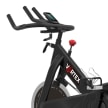
An exercise bike is a stationary cycling machine designed for indoor cardiovascular workouts.
Unlike outdoor cycling, an exercise bike allows you to control your workout environment, adjust resistance and train regardless of weather conditions.
Exercise bikes are commonly used for:
- Cardiovascular fitness and endurance
- Low-impact aerobic exercise
- General fitness and weight management
- Interval training
- Home gym workouts
- Commercial gym cardio training
Most exercise bikes allow riders to increase or decrease resistance to adjust workout intensity.
Depending on the model, additional features may include workout programmes, performance tracking, heart-rate monitoring and connectivity with compatible fitness applications.
2. Types of Exercise Bikes: Which Is Best?
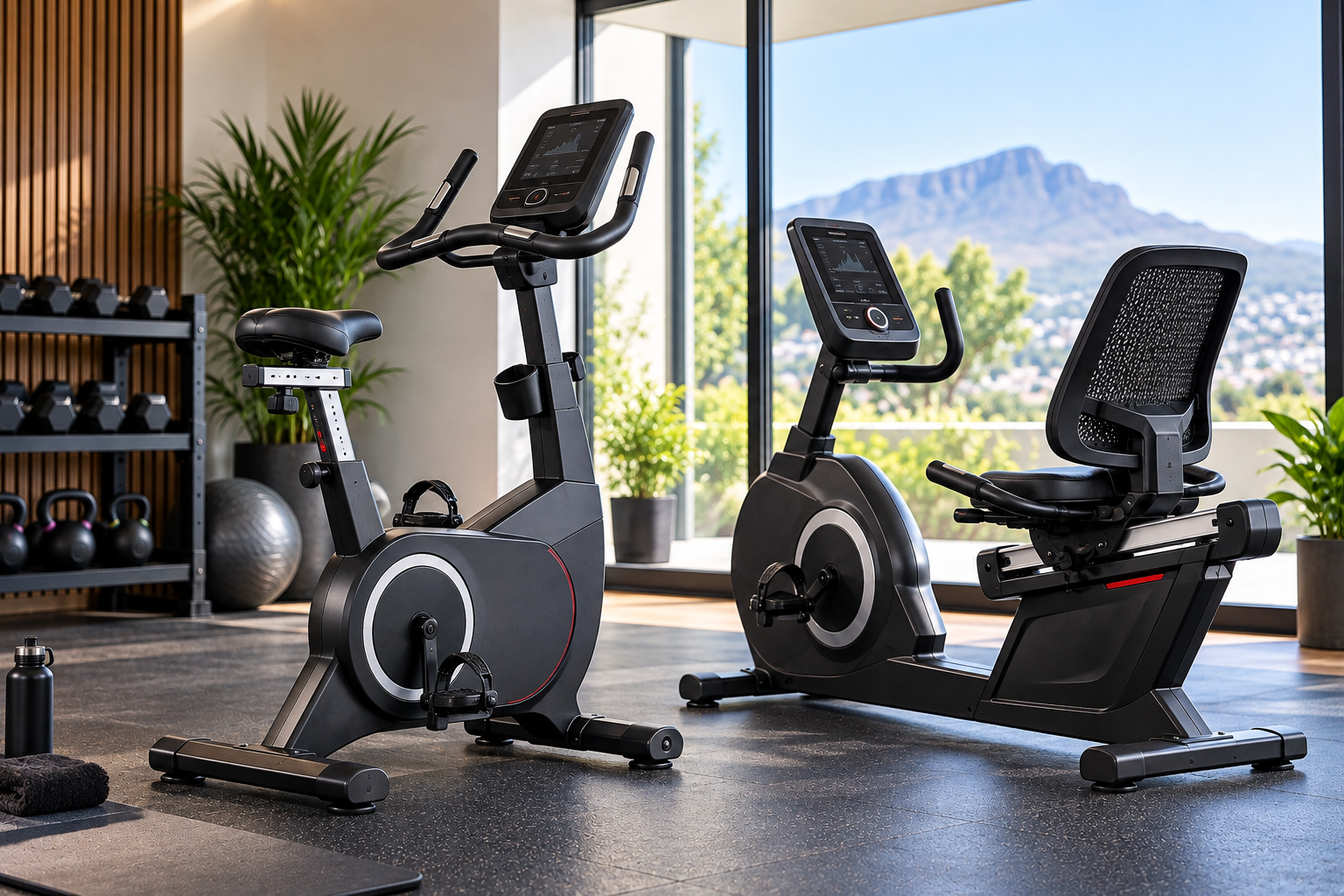
The three main exercise bike styles are upright, recumbent and studio-style spinning bikes.
Each offers different advantages depending on your preferred riding position and training goals.
Upright Exercise Bikes
An upright exercise bike positions the rider relatively upright, with the pedals beneath the body and handlebars in front.
This riding position is familiar to many people who have used traditional bicycles.
Upright bikes are suitable for steady cardiovascular exercise, endurance training and general home fitness.
Advantages of upright exercise bikes:
- Familiar seated cycling position
- Suitable for beginners and experienced users
- Often a relatively compact footprint
- Adjustable resistance for different fitness levels
- Available with basic or advanced consoles
An upright bike is a practical choice if you want regular indoor cycling without the more forward-leaning position associated with spinning bikes.
Recumbent Exercise Bikes
A recumbent exercise bike features a larger seat with back support and pedals positioned in front of the rider.
This creates a more reclined cycling position.
Recumbent bikes are particularly appealing to people who prefer supported seating during exercise.
Advantages of recumbent exercise bikes:
- Supportive seat and backrest
- More reclined riding position
- Often easier access through a step-through frame
- Suitable for comfortable, steady cardiovascular workouts
- May appeal to users who find traditional bicycle saddles uncomfortable
Recumbent bikes generally require more floor space than upright bikes, so check the assembled dimensions before purchasing.
Spinning Bikes and Indoor Cycles
Spinning bikes are designed for a cycling-focused riding experience, often involving a forward-leaning posture.
They commonly accommodate seated cycling, standing climbs and higher-intensity interval workouts.
Advantages of spinning bikes:
- Suitable for indoor cycling classes
- Adjustable resistance for varied workouts
- Designed for a more performance-oriented riding position
- Often suitable for seated and standing efforts
- Available for home and commercial applications
Shop Spinning Bikes at Fitness Network
3. Upright vs Recumbent vs Spinning Bikes
| Feature | Upright Exercise Bike | Recumbent Exercise Bike | Spinning Bike |
|---|---|---|---|
| Riding position | Relatively upright | Reclined with back support | Generally forward-leaning |
| Seat | Bicycle-style saddle | Larger seat with backrest | Cycling-style saddle |
| Pedal position | Below the rider | In front of the rider | Below the rider |
| Workout style | General cardio and endurance | Supported cardio and endurance | Indoor cycling and intervals |
| Standing pedalling | Usually not intended | Not intended | Commonly supported |
| Space requirements | Often compact | Generally longer footprint | Varies by model |
| Best suited to | General home fitness | Riders preferring supported seating | Cycling-focused training |
Our recommendation: Choose an upright bike for straightforward cardiovascular training, a recumbent bike if supported seating is your priority, or a spinning bike if you prefer a cycling-focused workout with more varied riding positions.
The best exercise bike is ultimately the one that fits your body comfortably and encourages consistent use.
4. How to Choose the Right Exercise Bike
Several important features should be considered before buying an exercise bike.
Seat Comfort and Adjustability
A comfortable riding position is essential, particularly for longer workouts.
Check whether the seat can be adjusted to accommodate your height and leg length.
At the bottom of the pedal stroke, your knee should remain slightly bent rather than fully locked.
For upright and spinning bikes, consider saddle height and any available forward-backward adjustment.
For recumbent bikes, confirm that the seat can be positioned so you reach the pedals without overextending your legs.
Handlebar Position
Handlebar adjustment can influence riding comfort and posture.
Check whether the handlebars offer vertical or horizontal adjustment, especially if several people will use the bike.
You should be able to reach the handlebars without excessive stretching or rounding your back.
Maximum User Weight
Always check the manufacturer's specified maximum user weight.
This is particularly important for shared home gyms and commercial environments.
Choose a bike that comfortably accommodates the intended users and is rated for the expected type of use.
Frame Stability
A stable frame contributes to a more comfortable and controlled cycling experience.
Check the base construction and whether the bike includes adjustable levelling feet.
Stability is particularly important for spinning bikes used during standing cycling efforts.
5. Understanding Exercise Bike Resistance Systems
Resistance determines how difficult it is to pedal.
Different exercise bikes use different systems to provide resistance.
Magnetic Resistance
Magnetic resistance systems use magnets to create resistance without requiring a friction pad to press directly against the flywheel.
Depending on the model, resistance may be adjusted manually or electronically.
Magnetic resistance is popular in home exercise bikes because it can offer smooth operation with relatively low resistance-system wear.
Friction Resistance
Friction resistance systems use a pad that presses against a rotating flywheel.
These systems are commonly associated with traditional spinning bikes.
They offer straightforward mechanical resistance adjustment but may require periodic inspection or replacement of the friction pad.
Air Resistance
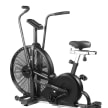
Air bikes use a fan to generate resistance as the rider pedals.
On many air bikes, resistance increases as pedalling effort increases.
Some models also incorporate moving handlebars, allowing upper-body participation.
Air bikes are particularly popular for high-intensity conditioning and functional training.
Resistance Comparison
| Resistance type | How it works | Common applications |
|---|---|---|
| Magnetic | Magnets create resistance | Upright, recumbent and spinning bikes |
| Friction | Pad contacts the flywheel | Traditional spinning bikes |
| Air | Fan resistance increases with effort | Air bikes and conditioning equipment |
No resistance system is automatically best for everyone. Choose according to workout preferences, maintenance requirements and the specific bike's design.
6. Exercise Bike Consoles and Workout Features
Modern exercise bikes offer a variety of console and workout features.
Depending on the model, a console may display:
- Workout duration
- Speed
- Distance
- Cadence or RPM
- Estimated calories
- Heart rate
- Resistance level
- Power output
Some exercise bikes also include preset training programmes, electronic resistance control or connectivity with compatible fitness applications.
Before paying extra for advanced technology, consider whether you will actually use those features.
For general home cardio, a straightforward console may be sufficient.
For structured training, performance tracking and interval workouts, additional metrics and connectivity may be worthwhile.
Always confirm the exact features included with the model you are considering.
7. How Much Space Does an Exercise Bike Need?
Exercise bikes can be suitable for relatively compact home training spaces, but their dimensions vary significantly.
Before purchasing, measure the area where you intend to position the bike.
Consider:
- Overall length, width and height
- Space needed to get on and off
- Clearance around nearby furniture
- Access to a power outlet if required
- Floor stability
- Transport wheels or moving requirements
- Ventilation during exercise
Recumbent bikes generally require more length than upright bikes because the pedals are positioned in front of the seat.
Spinning bikes and upright bikes may offer more compact footprints, although this depends on the specific model.
A protective exercise equipment mat can help protect the underlying floor and define your workout area.
8. Best Exercise Bikes to Consider at Fitness Network
Fitness Network offers exercise bikes for different budgets, fitness levels and training environments.
The following models are useful starting points when comparing options.
Vanguard Fitness PU2.4 Performance Upright Bike
The Vanguard Fitness PU2.4 is an upright exercise bike worth considering for customers who prefer a conventional seated cycling position.
It is listed within Fitness Network's commercial exercise bike range.
Compare its adjustment options, console and dimensions with your training requirements.
Schwinn 590U Upright Exercise Bike
The Schwinn 590U is another upright exercise bike available through Fitness Network.
It provides an alternative for customers comparing established fitness equipment brands and upright cycling options.
Check the current product specifications for console features, workout programmes and adjustment options.
Vanguard Fitness PR2.4 Performance Recumbent Bike
The Vanguard Fitness PR2.4 is a recumbent exercise bike designed around a supported seated riding position.
It is worth considering if comfort, back support and a reclined cycling posture are important purchasing factors.
Schwinn 590R Recumbent Exercise Bike
The Schwinn 590R offers another recumbent cycling option for customers seeking a supported seated workout.
Compare its seat adjustment, console functionality and overall dimensions with other recumbent models.
Horizon 5.0R-21 Recumbent Bike
The Horizon 5.0R-21 is another recumbent bike listed by Fitness Network.
It is an additional option for buyers comparing recumbent exercise bikes across different brands and budgets.
Vision Fitness U60 Commercial Upright Exercise Bike
The Vision Fitness U60 is positioned within the commercial upright exercise bike range.
It is worth comparing for fitness facilities and buyers seeking equipment suited to more demanding usage environments.
Vision Fitness R60 Commercial Recumbent Exercise Bike
The Vision Fitness R60 is a commercial recumbent cycling option.
It is worth considering for facilities that want to provide a supported seated cycling experience alongside other cardio equipment.
Which Exercise Bike Should You Choose?
For general home fitness, compare the Vanguard PU2.4 and Schwinn 590U if you prefer upright cycling.
For supported seating, compare the Vanguard PR2.4, Schwinn 590R and Horizon 5.0R-21.
For commercial applications, the Vision Fitness U60 and R60 are useful models to investigate.
Compare Exercise Bikes at Fitness Network
9. Exercise Bikes for Weight Loss and Cardiovascular Fitness
Exercise bikes can be an effective part of a balanced fitness routine.
Regular cycling can help improve cardiovascular endurance, increase physical activity and support weight management.
The amount of energy used during a workout depends on several factors, including:
- Workout duration
- Resistance level
- Pedalling intensity
- Body size
- Individual fitness level
A steady cycling session can support general aerobic fitness, while interval workouts provide opportunities to vary effort and recovery.
For weight management, consistency and appropriate nutrition are important alongside exercise.
No exercise bike can specifically target fat loss from one area of the body.
10. New vs Secondhand Exercise Bikes
Buying a secondhand exercise bike may reduce the initial purchase cost, but condition and maintenance history are important.
Before buying a used bike, inspect the frame, pedals, seat adjustment, resistance mechanism and console.
If possible, test the bike at different resistance levels and listen for unusual noises.
Check whether replacement parts are available and whether the machine has been maintained appropriately.
Buying a new exercise bike may offer advantages such as current product documentation, manufacturer warranty coverage and access to supplier support.
Always compare the complete purchase, including condition, warranty, delivery and expected usage.
11. Exercise Bike Buying Checklist
Before making your purchase, consider the following:
- Which type of exercise bike suits my preferred riding position?
- Can the seat and handlebars be adjusted comfortably?
- Is the resistance system suitable for my workouts?
- Does the console provide the information I need?
- What is the maximum supported user weight?
- Will the bike fit comfortably in my available space?
- Does the machine require mains power?
- Is the bike intended for home or commercial use?
- What warranty and after-sales support are available?
- What are the delivery and assembly requirements?
Taking time to compare these features can help you choose an exercise bike that remains useful as your fitness improves.
Frequently Asked Questions About Exercise Bikes
Is 20 minutes a day on an exercise bike enough to lose weight?
Twenty minutes of daily cycling can contribute to increased physical activity and energy expenditure.
However, weight loss depends on overall energy balance, nutrition, workout intensity and consistency.
For some people, 20 minutes may be a useful starting point, while others may gradually increase their workout duration as fitness improves.
Regular exercise combined with sustainable eating habits is generally more effective than relying on cycling alone.
What is the best stationary bike for home?
The best stationary bike depends on your preferred riding position, fitness goals, available space and budget.
An upright exercise bike is a practical choice for general cardiovascular fitness.
A recumbent bike may be more suitable if you prefer a supportive seat and reclined position.
A spinning bike may appeal to riders who enjoy indoor cycling classes, standing climbs and interval training.
Choose a model that fits your body comfortably and provides the features you will regularly use.
What is the difference between a stationary bike and an exercise bike?
The terms stationary bike and exercise bike are generally used interchangeably.
Both describe bicycles designed for indoor exercise without travelling forward.
Stationary bikes include several styles, such as upright exercise bikes, recumbent bikes and spinning bikes.
The main differences are the riding position, resistance system and intended workout experience.
How long should a beginner ride an exercise bike?
Beginners may start with approximately 10–20 minutes of comfortable cycling, depending on their fitness level and exercise tolerance.
As endurance improves, workout duration and resistance can gradually increase.
Focus on a comfortable riding position, manageable effort and consistent technique.
If you have an existing health condition or are returning to exercise after a long break, seek appropriate professional guidance before beginning a demanding programme.
Can you lose belly fat by riding an exercise bike?
Exercise bike workouts can contribute to overall fat loss when combined with suitable nutrition and regular physical activity.
However, cycling cannot specifically target belly fat.
Fat loss occurs across the body, and results vary according to individual factors, including energy balance, genetics and lifestyle.
Consistent cardiovascular exercise and strength training can both support a balanced fitness programme.
Is biking 30 minutes a day enough exercise?
Thirty minutes of cycling on most days can make a meaningful contribution to general physical activity.
For adults, widely used public-health guidance recommends at least 150 minutes of moderate-intensity aerobic activity per week, or an equivalent amount of vigorous activity, alongside muscle-strengthening exercise on at least two days.
The benefits of a 30-minute ride depend partly on intensity and individual fitness level.
A combination of cycling, strength training and appropriate recovery can support overall fitness.
Which muscles does an exercise bike work?
Exercise bikes primarily involve the lower-body muscles.
These include the quadriceps, hamstrings, glutes and calf muscles.
The core also contributes to maintaining a stable riding position.
Spinning bikes may place different demands on posture and stabilising muscles during standing efforts, while recumbent bikes provide additional seated support.
For balanced strength development, combine cycling with suitable resistance training.
Does an exercise bike need to be plugged in?
Not all exercise bikes require mains electricity.
Some models use manually adjusted resistance and battery-powered consoles.
Others use electronic resistance systems or powered displays that may require an electrical connection.
Certain commercial exercise bikes are self-generating, using pedalling energy to power their consoles.
Always check the manufacturer's specifications before purchasing.
Find the Right Exercise Bike at Fitness Network
Choosing the right exercise bike is about more than comparing prices.
A comfortable riding position, appropriate resistance system, stable construction and useful console features can all influence your long-term training experience.
Whether you prefer an upright exercise bike, a supportive recumbent bike or a spinning bike for performance-focused workouts, selecting equipment suited to your needs can make indoor cycling more enjoyable.
At Fitness Network, we offer exercise bikes for home and commercial use from brands including Vanguard Fitness, Schwinn, Horizon Fitness and Vision Fitness.
Explore the range, compare models and find an exercise bike suited to your fitness goals, available space and budget.