










What Is a Dumbbell Floor Press?
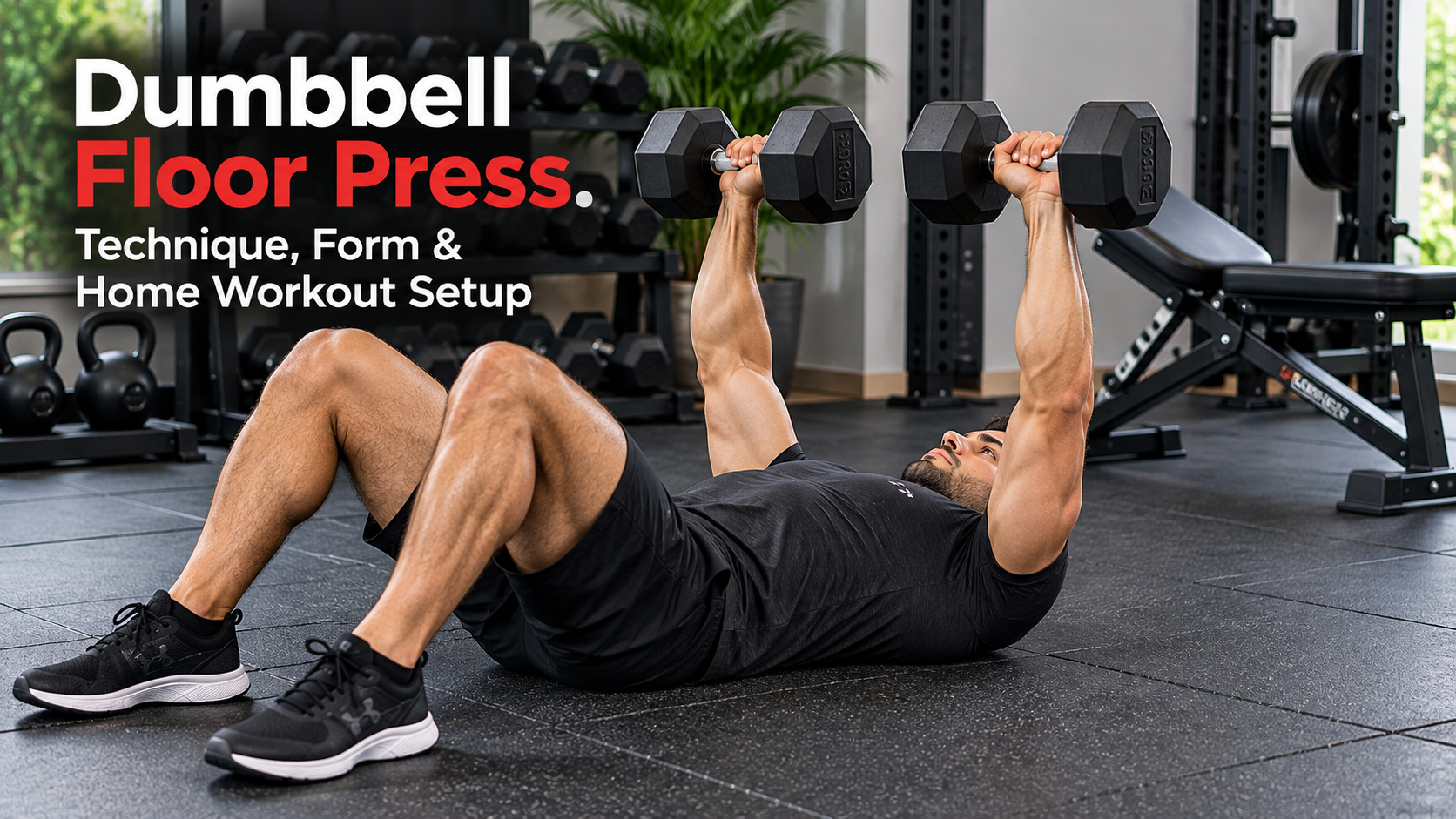
A dumbbell floor press is performed lying on your back with your knees bent and feet on the floor.
You begin with a dumbbell in each hand positioned around chest level, press the weights upwards and then lower them under control until your upper arms gently contact the floor.
That contact with the floor is the key difference between a floor press and a conventional bench press.
On a bench, your elbows can travel below the level of your torso. During a floor press, the floor stops your upper arms earlier.
This creates a shorter pressing range of motion.
It doesn't make the floor press inherently better or worse than bench pressing. It simply makes it a different variation that can be useful depending on your equipment and training programme.
Check Your Dumbbells and Training Space
Before starting, make sure you have enough room to lie down and press the dumbbells without hitting furniture or other gym equipment.
You don't need a bench for this exercise, but you do need:
- A pair of manageable dumbbells
- A stable, non-slip floor
- Sufficient space around your shoulders and arms
- Adequate overhead clearance
- A clear area for safely setting the weights down
Remove loose objects from the training area before you begin.
If you're training on a hard surface, suitable gym flooring or an exercise mat can make the training area more comfortable while helping protect the underlying floor.
Choose the Right Dumbbell Weight
Start with dumbbells you can comfortably bring into position and lower under control.
Don't choose a weight simply because you can press it once.
You need enough control to complete an entire set while maintaining consistent wrist, elbow and shoulder positioning.
If you're learning the exercise for the first time, begin lighter than you think you need. Once your technique becomes consistent, resistance can be increased progressively.
Both fixed and adjustable dumbbells work well for floor presses.
How to Get Into Position for a Dumbbell Floor Press
Getting into and out of position is an important part of the exercise, particularly as the dumbbells become heavier.
- Sit on the floor with your knees bent and the dumbbells close to your hips.
- Grip both dumbbells securely.
- Keep the weights close to your body as you lower yourself towards the floor.
- Bring the dumbbells towards your chest as you lie back.
- Position your head, upper back and hips comfortably on the floor.
- Plant your feet securely.
- Pause and make sure both dumbbells are under control before beginning your first repetition.
Avoid lying down first and then trying to reach sideways for heavy dumbbells.
If you cannot safely get the weights into position, use lighter dumbbells.
How to Perform a Dumbbell Floor Press
Once you're correctly positioned:
- Hold a dumbbell in each hand around chest level.
- Keep your wrists reasonably straight and aligned over your forearms.
- Position your elbows at a comfortable angle rather than flaring them directly out to the sides.
- Brace your torso and keep your upper back in contact with the floor.
- Press both dumbbells upwards under control.
- Extend your arms comfortably without aggressively locking your elbows.
- Lower the weights slowly.
- Allow your upper arms to make gentle contact with the floor.
- Do not bounce your arms off the floor.
- Press upwards again and repeat.
The dumbbells may move slightly towards one another as you press, but they don't need to collide at the top.
Aim for consistent repetitions rather than rushing the movement.
Dumbbell Floor Press Grip and Elbow Position
Your palms can face forwards or turn slightly inwards.
Some users prefer a more neutral grip because it can feel comfortable and allows the elbows to remain somewhat closer to the torso.
There is no need to force your elbows tightly against your body, nor should they necessarily flare directly sideways.
Aim for a natural position where your hands, wrists and elbows remain well aligned.
Your wrists should remain reasonably straight rather than bending significantly backwards under the weight.
What Muscles Does the Dumbbell Floor Press Work?
The dumbbell floor press primarily trains the:
Chest (pectorals)
Triceps
Front shoulders
Because the floor limits the bottom portion of the movement, the exercise places particular emphasis on the middle and upper portion of the press, where the triceps make a significant contribution.
The chest is still heavily involved.
This is why the floor press shouldn't be considered merely a triceps exercise. It remains a compound pressing movement involving several upper-body muscle groups.
Dumbbell Floor Press vs Dumbbell Bench Press
The biggest difference is range of motion.
Dumbbell Floor Press
Your upper arms stop when they reach the floor.
This means:
- Shorter pressing range
- No bench required
- Easy to incorporate into a minimal home gym
- Useful variation for chest and triceps training
Dumbbell Bench Press
A bench raises your torso from the floor, allowing your elbows to travel farther down.
This provides:
- Greater available range of motion
- More exercise-angle options
- Flat and incline pressing possibilities
- A more conventional dumbbell chest-training setup
Neither exercise has to replace the other.
If you have an adjustable bench, you can use both movements within a broader strength programme.
For an angled pressing variation, see our:
Dumbbell Incline Press: Setup, Form, Bench Angle & Equipment
Common Dumbbell Floor Press Mistakes
Bouncing Your Arms Off the Floor
Your upper arms should touch the floor gently.
Don't drop rapidly and use the floor to rebound into the next repetition.
Using Too Much Weight
If you can't control the dumbbells during both the press and lowering phase, reduce the resistance.
Excessively Flaring Your Elbows
Allow your elbows to follow a comfortable path rather than pointing directly sideways.
Bending Your Wrists Back
Keep your wrists reasonably aligned with your forearms.
If the dumbbells continually pull your hands backwards, the load may be too heavy.
Uneven Pressing
Both dumbbells should move under control.
If one arm consistently moves faster or the dumbbell begins drifting, reduce the resistance or end the set.
Lifting Your Hips
Keep your hips on the floor during a conventional dumbbell floor press.
Driving your hips upwards changes the movement and effectively turns it into a different exercise.
Rushing the Lowering Phase
Lowering the dumbbells is part of the repetition.
Control the descent until your upper arms gently reach the floor.
How to Finish the Set Safely
Don't wait until you have completely exhausted yourself before considering how you're going to put the dumbbells down.
After your final repetition:
- Lower the dumbbells under control.
- Bring them towards your chest.
- Keep the weights close to your body.
- Carefully roll or sit up using a controlled movement.
- Place the dumbbells securely on the floor.
Avoid throwing the dumbbells away from your body.
This is particularly important with adjustable dumbbells, which contain selection and locking mechanisms and should be handled according to the manufacturer's instructions.
Fixed vs Adjustable Dumbbells for Floor Presses
Both are suitable.
Fixed Dumbbells
Fixed dumbbells are simple to use and allow you to move quickly between weights.
They're ideal when you have sufficient room for multiple pairs and potentially a dumbbell rack.
Dumbbell Sets
A complete dumbbell set provides several weight increments, making it easier to progress or accommodate multiple users.
Adjustable Dumbbells
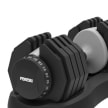
Adjustable dumbbells can provide multiple resistance levels while occupying considerably less storage space.
This makes them particularly useful for home gyms.
Fitness Network's BowFlex SelectTech range gives us two particularly relevant options.
BowFlex 552i SelectTech Adjustable Dumbbells
The BowFlex 552i SelectTech Adjustable Dumbbells are a versatile option for general home strength training.
Each dumbbell adjusts from approximately 2.3kg to 23.8kg, providing 15 weight settings.
That allows the same system to be used for lighter exercises such as curls and raises as well as progressively heavier exercises including floor presses, incline presses and rows.
The relatively low starting weight also makes the 552i particularly versatile where several exercises require very different levels of resistance.
Best suited to: general home strength training, compact home gyms and users wanting a wide range of resistance in a small footprint.
BowFlex 1090i SelectTech Adjustable Dumbbell
For stronger users, the BowFlex 1090i SelectTech Adjustable Dumbbell offers considerably greater resistance.
Each dumbbell adjusts from approximately 4.5kg to 40.8kg across 17 weight settings.
That makes the 1090i particularly useful for exercises where users may progress to heavier loads, including floor presses, dumbbell rows and other compound strength movements.
Best suited to: experienced home lifters and users wanting greater long-term progression.
Dumbbell Floor Press vs Incline Press vs Shoulder Press
These three exercises work well together but shouldn't be confused.
| Exercise | Position | Primary emphasis | Equipment |
|---|---|---|---|
| Dumbbell Floor Press | Lying on floor | Chest & triceps | Dumbbells |
| Incline Dumbbell Press | Reclined bench | Upper chest & shoulders | Dumbbells + bench |
| Dumbbell Shoulder Press | Seated/standing | Shoulders & triceps | Dumbbells; bench optional |
If you're building a dumbbell-based home strength programme, learning all three provides several pressing options without requiring large strength machines.
Dumbbell Floor Press FAQs
Is a dumbbell floor press effective?
Yes. The dumbbell floor press is an effective compound upper-body exercise for training the chest and triceps, with the shoulders assisting. Its shorter range of motion makes it different from a bench press rather than simply a substitute for one.
Why do a floor press instead of a bench press?
A floor press requires no weight bench and is therefore particularly convenient for home training. The floor also limits how far the upper arms can descend, creating a shorter pressing range that provides a useful variation from conventional bench pressing.
Which muscles does the floor press target?
The dumbbell floor press primarily trains the chest and triceps, while the front shoulders assist with the pressing movement.
How do you do a floor press with dumbbells?
Lie on your back with your knees bent and feet planted. Hold the dumbbells around chest level, keep your wrists aligned over your forearms and press the weights upwards. Lower them slowly until your upper arms gently contact the floor, then press again without bouncing.
Are floor presses harder than bench presses?
Not necessarily. The floor press uses a shorter range of motion than a bench press, but the amount of weight a person can use depends on their technique, experience and individual strengths. Treat them as different exercises rather than judging one as universally harder.
What weight should a beginner use for dumbbell floor presses?
There is no universal beginner weight. Start with dumbbells light enough to position safely and control throughout every repetition. Once you can complete your intended sets with consistent technique, increase the resistance gradually.
Can you do a floor press with one dumbbell?
Yes. A floor press can be performed one arm at a time. Single-arm pressing changes the stability demands because your torso must resist rotating as you press the weight. Start lighter while learning the variation.
How many reps should you do for dumbbell floor presses?
The appropriate repetition range depends on your programme and training goal. A common approach is 2–4 working sets using controlled repetitions, but technique should determine when a set ends. Stop when you can no longer maintain a stable position and controlled movement.
Build Your Home Dumbbell Training Setup
One of the advantages of dumbbell training is that you don't need a room full of equipment to build a versatile strength setup.
A suitable pair of dumbbells gives you access to floor presses, rows, shoulder presses, squats, lunges, curls and numerous other exercises.
Add an adjustable bench and you can expand into flat presses, incline presses, seated shoulder exercises and additional supported movements.